What is an FFR Machine in Cardiology?
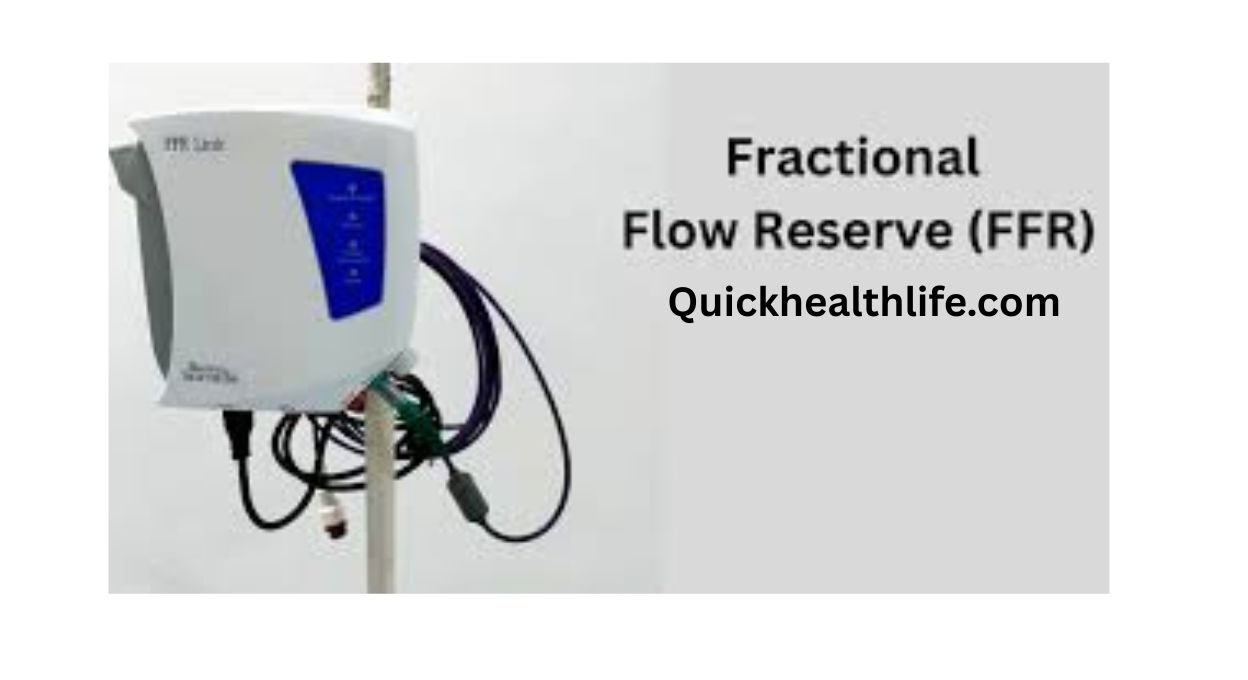
An FFR machine is a specialized medical device used in cardiology to measure the blood pressure and flow inside coronary arteries — the arteries that supply blood to the heart.
It helps doctors decide whether a narrowing (blockage) in the arteries is really causing a problem in blood flow or not.
In simpler terms:
👉 FFR tells how much a blockage is affecting the heart’s oxygen supply.
This test is done during angiography or angioplasty to check the severity of blockage before inserting a stent.
Table of Contents
Full Form of FFR
FFR stands for Fractional Flow Reserve.
It measures the ratio of blood flow in a narrowed artery compared to the normal flow.
Formula for FFR: FFR=PressuredistalPressureaortaFFR = \frac{Pressure_{distal}}{Pressure_{aorta}}FFR=PressureaortaPressuredistal
Where:
- Pressure distal: Pressure after the blockage
- Pressure aorta: Pressure before the blockage
Why FFR is Important in Cardiology
Traditional angiography only shows the structure of arteries — it cannot confirm if the blockage is really reducing blood flow.
That’s where FFR helps. It provides functional information.
Benefits of FFR Machine in Cardiology
- Helps avoid unnecessary stenting
- Improves treatment accuracy
- Reduces risk of complications
- Provides real-time measurement
- Enhances patient outcomes
How Does the FFR Machine Work?
The working of an FFR machine is based on pressure sensing using a guide wire.
Here’s a step-by-step process:
- Angiography Setup:
The doctor performs a coronary angiography to find the narrowed arteries. - Insertion of Pressure Wire:
A thin pressure wire is inserted into the coronary artery through a catheter. - Drug Infusion:
A vasodilator drug (like Adenosine) is given to widen the arteries and create maximum blood flow. - Pressure Measurement:
The FFR machine measures the pressure before and after the blockage using sensors on the wire. - FFR Calculation:
The device automatically calculates the Fractional Flow Reserve (FFR value). - Decision Making:
Based on FFR results, doctors decide whether a stent is necessary.
Normal Range of FFR in Cardiology
Understanding the FFR values is very important for treatment decisions.
| FFR Value | Interpretation | Treatment Suggestion |
|---|---|---|
| > 0.80 | Normal blood flow | No stent needed |
| 0.75 – 0.80 | Borderline case | Consider symptoms & other tests |
| < 0.75 | Reduced blood flow | Stenting recommended |
FFR vs Angiography: What’s the Difference?
| Feature | FFR (Fractional Flow Reserve) | Angiography |
|---|---|---|
| Purpose | Measures blood flow and pressure | Shows artery structure |
| Accuracy | High (functional test) | Moderate (visual test) |
| Decision Making | Confirms need for stent | May overestimate blockages |
| Drug Use | Adenosine used | No drug used |
| Cost | Slightly higher | Standard procedure |
| Technology | Pressure wire based | X-ray dye imaging |
Conclusion:
FFR gives a more accurate picture of whether a blockage is truly harmful or not.
Types of FFR Machines
Over time, technology has improved and different types of FFR systems are available:
1. Wire-Based FFR Machines
- Use pressure wires inserted into arteries.
- Most accurate and widely used method.
2. Wire-Free (Angiography-Based) FFR
- Uses AI and imaging software to estimate FFR from angiographic images.
- Non-invasive and faster.
3. Hybrid IVUS + FFR Machines
- Combine Intravascular Ultrasound (IVUS) and FFR for 3D imaging and flow assessment.
What is IVUS and How is it Related to FFR?
IVUS stands for Intravascular Ultrasound.
It is another advanced tool used in cardiology to see inside the arteries with ultrasound imaging.
FFR vs IVUS
| Feature | FFR | IVUS |
|---|---|---|
| Measures | Blood flow pressure | Artery wall structure |
| Purpose | Check if blockage reduces flow | Visualize plaque and artery wall |
| Type | Functional test | Imaging test |
| Combination Use | Often used together for best results | — |
When used together, FFR + IVUS gives the most accurate diagnosis for heart blockages.
FFR Test Procedure
Here’s what happens during an FFR procedure step by step:
- Preparation:
- Patient is given local anesthesia.
- ECG and blood pressure are monitored.
- Catheter Insertion:
- A catheter is inserted through the groin or wrist artery.
- Pressure Wire Placement:
- A special wire connected to the FFR machine is placed across the suspected blockage.
- Drug Administration:
- Adenosine or Papaverine is used to maximize blood flow.
- Measurement:
- The machine records pressures and calculates the FFR value.
- Analysis:
- Doctor evaluates the FFR reading to decide if a stent is needed.
Duration: The FFR procedure usually takes 15–30 minutes.
Safety: It is safe and minimally invasive.
What Drug is Used for FFR?
The most common drug used during an FFR test is Adenosine.
It helps dilate the coronary arteries temporarily to achieve maximum blood flow.
Other alternatives include:
- Papaverine
- Regadenoson
- ATP (Adenosine Triphosphate)
FFR Machine Price in India
The cost of FFR equipment can vary depending on brand and features.
| Brand / Model | Approx. Price (INR) | Type |
|---|---|---|
| Philips Volcano FFR | ₹25–35 Lakhs | Wire-based |
| Abbott PressureWire X | ₹28–40 Lakhs | Wireless option |
| Boston Scientific FFR System | ₹30–38 Lakhs | Hybrid system |
Note:
These are approximate prices and can vary depending on hospital setup, accessories, and service packages.
FFR Test Cost in India
If you are a patient, here’s the cost breakdown for getting an FFR test done in India:
| City | Average FFR Test Cost (INR) |
|---|---|
| Delhi | ₹35,000 – ₹50,000 |
| Mumbai | ₹30,000 – ₹45,000 |
| Bangalore | ₹32,000 – ₹48,000 |
| Chennai | ₹28,000 – ₹40,000 |
| Hyderabad | ₹30,000 – ₹42,000 |
On average, FFR test price in India ranges between ₹30,000 and ₹50,000, depending on the hospital.
IVUS Machine Cost in India
For comparison, here’s the price of IVUS (Intravascular Ultrasound) machines:
| Brand | Approx. Cost (INR) |
|---|---|
| Boston Scientific | ₹35–45 Lakhs |
| Philips Volcano IVUS | ₹40–55 Lakhs |
| Abbott OptiCross | ₹42–58 Lakhs |
IVUS and FFR are often used together for better diagnostic accuracy.
Disadvantages of FFR
While FFR is highly useful, it has some limitations:
- Slightly higher cost than angiography
- Requires special equipment and training
- May cause temporary chest discomfort due to Adenosine
- Not suitable for very small arteries
- Time-consuming if multiple arteries are tested
Even with these limitations, the benefits outweigh the drawbacks.
Recent Advances in FFR Technology
Modern FFR systems have become smarter and faster:
- AI-based FFR-CT (non-invasive, from CT scans)
- Wireless FFR wires
- Improved accuracy with real-time imaging
- Integration with 3D imaging and IVUS
These innovations are helping cardiologists perform safer and faster diagnoses.
Clinical Importance of FFR
Doctors rely on FFR because it:
- Helps avoid unnecessary stents
- Reduces procedure costs long-term
- Improves patient survival
- Offers quantitative decision-making
In fact, global cardiology guidelines recommend FFR-guided stenting for intermediate lesions (50–70% blockage).
FAQs About FFR Machine and Procedure
1. What is the FFR machine in cardiology?
The FFR machine measures blood flow pressure inside heart arteries to check if a blockage is harmful.
2. What is the cost of FFR in cardiology?
In India, the FFR test typically costs between ₹30,000 and ₹50,000.
3. What is FFR and IVUS?
FFR measures pressure and flow; IVUS uses ultrasound to visualize the artery structure. They are often used together.
4. What drug is used for FFR?
Adenosine is commonly used to dilate the arteries during the test.
5. What is a normal FFR value?
An FFR value above 0.80 is considered normal.
6. Is the FFR test safe?
Yes, it’s a safe, minimally invasive, and reliable test with very low risk.
7. Is FFR better than angiography?
Yes, because FFR provides functional information about blood flow, not just structural details.